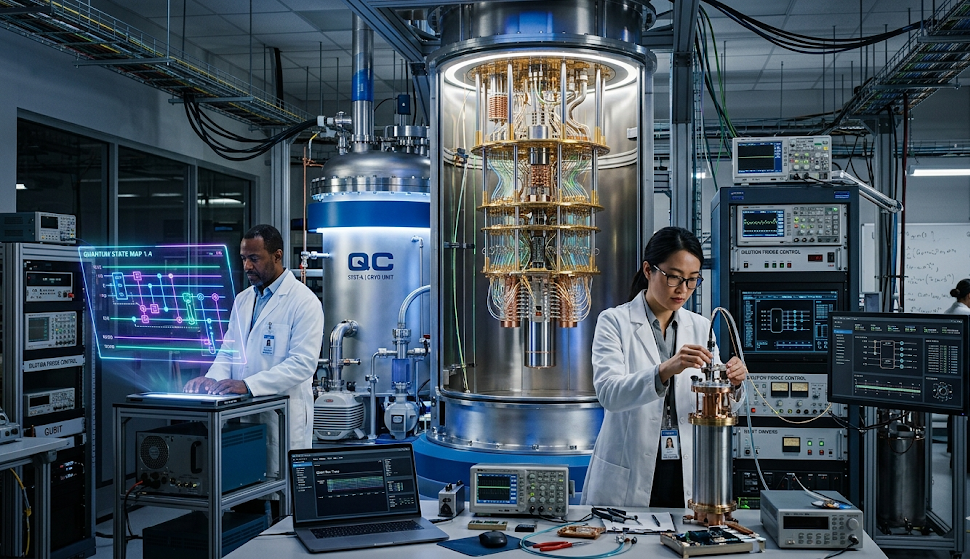
Technology has consistently transformed human civilization, from the invention of the wheel to the rise of the internet and artificial intelligence. Today, another revolutionary technology is emerging that could redefine the limits of computing and problem-solving: quantum computing. While still in its early stages of development, quantum computing has attracted significant attention from governments, technology companies, researchers, and investors due to its potential to solve problems that are beyond the capabilities of even the most powerful supercomputers.
Unlike traditional computers, which process information using bits represented as either 0 or 1, quantum computers utilize the principles of quantum mechanics to process information in fundamentally different ways. This allows them to perform certain calculations exponentially faster than classical computers. Experts believe quantum computing could revolutionize industries such as healthcare, finance, cybersecurity, logistics, artificial intelligence, climate science, and materials research.
The promise of quantum computing extends far beyond faster calculations. It has the potential to accelerate scientific discovery, optimize complex systems, enhance machine learning, and unlock solutions to challenges that currently seem impossible to solve. However, the technology also raises concerns regarding cybersecurity, economic disruption, and technological inequality.
Understanding Quantum Computing
Quantum computing is a branch of computing based on the principles of quantum mechanics, the field of physics that studies the behavior of matter and energy at the atomic and subatomic levels.
Traditional computers use binary bits as the smallest unit of information. A bit can exist in one of two states: 0 or 1. Every digital process, from browsing websites to running complex software, is ultimately built upon combinations of these binary states.
Quantum computers use quantum bits, commonly known as qubits. Unlike classical bits, qubits can exist in multiple states simultaneously due to a phenomenon known as superposition.
This unique property allows quantum computers to process enormous amounts of information at the same time, significantly increasing their computational power for specific types of problems.
The Science Behind Quantum Computing
To understand why quantum computing is so powerful, it is important to examine several key principles of quantum mechanics.
Superposition
Superposition allows qubits to exist as both 0 and 1 simultaneously until measured.
In classical computing, a bit must be either 0 or 1. A qubit, however, can represent multiple possibilities at once.
This capability dramatically expands the computational possibilities available to quantum systems.
Entanglement
Entanglement is another fundamental quantum phenomenon.
When qubits become entangled, the state of one qubit becomes directly related to the state of another, regardless of the distance between them.
This interconnectedness enables quantum computers to coordinate calculations in highly efficient ways.
Quantum Interference
Quantum interference helps guide computations toward correct solutions while reducing incorrect possibilities.
By combining superposition, entanglement, and interference, quantum computers can perform calculations that would be extremely difficult or impossible for traditional computers.
How Quantum Computers Differ from Classical Computers
Classical computers excel at everyday tasks such as:
- Web browsing
- Word processing
- Gaming
- Email communication
- Database management
- Software development
Quantum computers are not intended to replace classical computers for these activities.
Instead, they are designed to solve highly specialized problems involving massive datasets and complex calculations.
Examples include:
- Molecular simulations
- Optimization problems
- Cryptographic analysis
- Advanced machine learning
- Scientific modeling
For these tasks, quantum computers may eventually outperform traditional systems by significant margins.
The Evolution of Quantum Computing
The concept of quantum computing emerged in the 1980s when physicists began exploring the possibility of using quantum mechanics for computation.
Several milestones have shaped the field:
Early Theoretical Foundations
Researchers proposed that quantum systems could perform computations beyond the reach of classical machines.
This idea laid the groundwork for future development.
Development of Quantum Algorithms
Scientists later developed algorithms demonstrating the theoretical advantages of quantum computing.
These breakthroughs attracted widespread interest from academia and industry.
Commercial Investment
Major technology companies, startups, and governments have invested billions of dollars in quantum research and development.
This funding has accelerated progress in hardware, software, and quantum applications.
Recent Advances
Recent years have seen significant improvements in qubit stability, error correction, and computational capabilities.
While practical large-scale quantum computers remain under development, progress continues at a rapid pace.
Potential Impact on Healthcare
One of the most promising applications of quantum computing lies in healthcare.
Drug Discovery
Developing new medicines is a time-consuming and expensive process.
Quantum computers could simulate molecular interactions with unprecedented accuracy, helping researchers identify promising drug candidates more quickly.
This could significantly reduce research costs and accelerate medical breakthroughs.
Personalized Medicine
Quantum computing may enable more precise analysis of genetic and biological data.
Doctors could develop personalized treatment plans tailored to individual patients based on their unique genetic profiles.
Disease Modeling
Researchers could use quantum systems to better understand complex diseases such as:
- Cancer
- Alzheimer’s disease
- Parkinson’s disease
- Genetic disorders
Improved disease modeling may lead to more effective treatments and preventive strategies.
Medical Imaging
Quantum-enhanced algorithms could improve medical imaging technologies, allowing for earlier and more accurate diagnoses.
Revolutionizing Artificial Intelligence
Artificial intelligence and quantum computing represent two of the most transformative technologies of the modern era.
Together, they could unlock extraordinary possibilities.
Faster Machine Learning
Training advanced AI models requires enormous computational resources.
Quantum computers could process large datasets more efficiently, reducing training times and improving model performance.
Improved Pattern Recognition
Quantum algorithms may help AI systems identify patterns and relationships that are difficult for traditional computers to detect.
Advanced Decision-Making
Quantum-enhanced AI could improve decision-making in areas such as:
- Healthcare
- Finance
- Transportation
- Manufacturing
- Scientific research
The combination of AI and quantum computing may lead to breakthroughs across numerous industries.
Impact on Financial Services
The financial sector relies heavily on data analysis and risk assessment.
Quantum computing could transform many aspects of finance.
Portfolio Optimization
Investment firms must evaluate countless variables when constructing portfolios.
Quantum computers could analyze complex financial scenarios more effectively, helping optimize investment strategies.
Risk Analysis
Financial institutions face significant challenges in assessing market risks.
Quantum algorithms may provide more accurate risk models and improve forecasting capabilities.
Fraud Detection
Quantum-enhanced machine learning could strengthen fraud detection systems by identifying suspicious patterns more efficiently.
Trading Strategies
Advanced computational power may improve algorithmic trading and market analysis.
Transforming Cybersecurity
Cybersecurity is one of the most discussed aspects of quantum computing.
Threat to Existing Encryption
Many modern encryption methods rely on mathematical problems that are difficult for classical computers to solve.
Quantum computers could potentially solve some of these problems much faster, threatening existing security systems.
This has significant implications for:
- Banking
- Government communications
- Military systems
- Healthcare records
- Corporate data
Quantum-Safe Cryptography
Researchers are developing new cryptographic methods designed to withstand quantum attacks.
Governments and organizations worldwide are preparing for a future where quantum-resistant security becomes essential.
Enhanced Security Technologies
Quantum technologies may also improve cybersecurity through:
- Quantum encryption
- Secure communication networks
- Advanced authentication systems
These innovations could create stronger defenses against cyber threats.
Applications in Logistics and Supply Chains
Modern supply chains involve countless variables and optimization challenges.
Quantum computing could dramatically improve logistics operations.
Route Optimization
Transportation companies must determine the most efficient routes for vehicles, ships, and aircraft.
Quantum algorithms may solve these complex optimization problems more effectively.
Inventory Management
Businesses could better predict demand and optimize inventory levels.
This would reduce waste, lower costs, and improve customer satisfaction.
Global Supply Chain Efficiency
Quantum-powered analysis could help organizations manage disruptions, improve forecasting, and strengthen supply chain resilience.
Climate Change and Environmental Solutions
Climate change is one of the world’s most pressing challenges.
Quantum computing may contribute to environmental sustainability efforts.
Climate Modeling
Climate systems involve countless interconnected variables.
Quantum computers could improve climate simulations and forecasting accuracy.
Renewable Energy
Researchers may use quantum systems to develop more efficient:
- Solar panels
- Batteries
- Energy storage technologies
These innovations could accelerate the transition to clean energy.
Carbon Capture Technologies
Quantum simulations may help scientists discover new materials capable of capturing and storing carbon emissions more effectively.
Environmental Monitoring
Advanced computational capabilities could enhance environmental monitoring and resource management efforts.
Advancing Scientific Research
Quantum computing has the potential to revolutionize scientific discovery.
Materials Science
Scientists could design new materials with specific properties for use in:
- Electronics
- Aerospace
- Construction
- Energy systems
Chemical Simulations
Quantum systems are particularly well-suited for modeling molecular behavior.
This capability may unlock breakthroughs in chemistry and manufacturing.
Physics Research
Quantum computers could help researchers explore fundamental questions about the universe and advance our understanding of physical laws.
Space Exploration
Complex simulations related to spacecraft design, navigation, and planetary research may benefit from quantum computing.
Economic Impact of Quantum Computing
The emergence of quantum computing could generate substantial economic opportunities.
Creation of New Industries
Entire industries may emerge around:
- Quantum hardware
- Quantum software
- Quantum consulting
- Quantum cybersecurity
- Quantum cloud services
Increased Productivity
Organizations that successfully leverage quantum technologies may gain significant competitive advantages.
Workforce Development
Demand for professionals with expertise in quantum science and engineering is expected to grow rapidly.
Educational institutions are already expanding quantum-related programs.
Global Competition
Countries are investing heavily in quantum research to strengthen their technological leadership and economic competitiveness.
Challenges Facing Quantum Computing
Despite its enormous potential, quantum computing faces significant obstacles.
Hardware Limitations
Quantum systems remain highly sensitive to environmental disturbances.
Maintaining stable qubits is one of the field’s greatest technical challenges.
Error Rates
Quantum computations are prone to errors due to noise and interference.
Researchers continue developing advanced error-correction methods.
High Costs
Building and maintaining quantum computers requires specialized equipment and significant financial investment.
Talent Shortages
The field requires expertise in physics, computer science, mathematics, and engineering.
The shortage of qualified professionals may slow progress.
Scalability Issues
Researchers must overcome numerous technical barriers before large-scale quantum systems become commercially viable.
Ethical and Social Considerations
As quantum computing advances, important ethical questions emerge.
Technological Inequality
Access to quantum technologies may initially be concentrated among wealthy nations and large corporations.
This could widen existing technological and economic disparities.
Security Risks
The ability to break current encryption systems raises concerns about privacy and national security.
Responsible Development
Governments, researchers, and businesses must work together to ensure responsible innovation and equitable access.
Regulatory Challenges
Policymakers must develop frameworks that encourage innovation while addressing potential risks.
The Future of Quantum Computing
Although practical quantum computers remain in development, experts believe the technology will continue advancing rapidly over the coming decades.
Future milestones may include:
- Fault-tolerant quantum systems
- Commercial quantum applications
- Quantum internet networks
- Advanced scientific discoveries
- Widespread industry adoption
The timeline remains uncertain, but progress suggests that quantum computing will become increasingly important in the years ahead.
As hardware improves and practical applications emerge, organizations across industries will explore new ways to harness quantum capabilities.
Conclusion
Quantum computing represents one of the most exciting technological frontiers of the modern era. By leveraging the principles of quantum mechanics, these powerful systems have the potential to solve problems that are currently beyond the reach of classical computers. From healthcare and artificial intelligence to finance, cybersecurity, climate science, and scientific research, quantum computing could transform industries and accelerate innovation on a global scale.
The technology promises unprecedented computational power, enabling breakthroughs that may improve human health, strengthen economies, enhance sustainability, and expand scientific knowledge. At the same time, significant challenges remain, including technical limitations, cybersecurity concerns, ethical considerations, and the need for effective regulation.
While large-scale quantum computing is still evolving, its potential impact is undeniable. As investments continue and research advances, quantum computing may become one of the defining technologies of the 21st century, shaping the future of science, business, and society in ways that are only beginning to be understood.