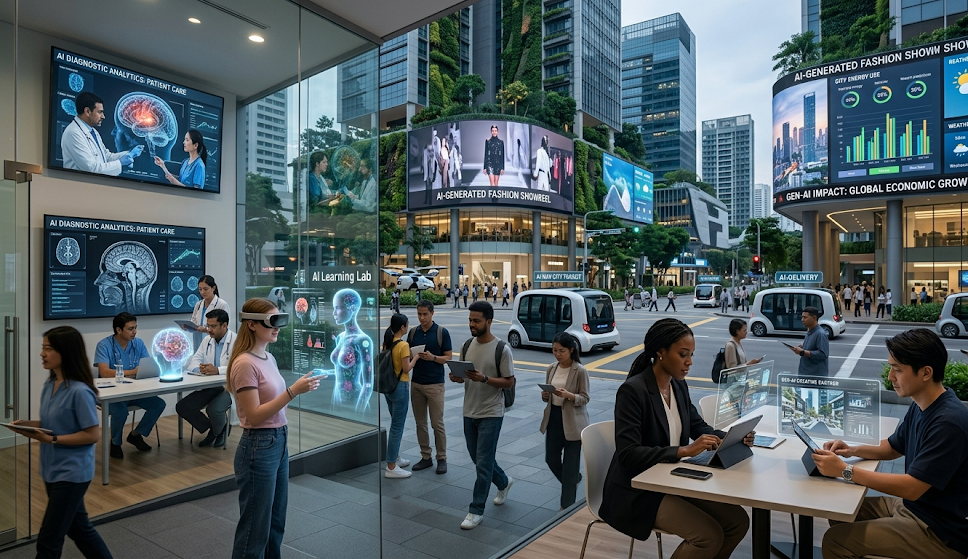
Generative Artificial Intelligence (AI) has rapidly evolved from a niche technological concept into one of the most transformative innovations of the 21st century. Unlike traditional AI systems that primarily analyze data and make predictions, generative AI can create entirely new content, including text, images, videos, music, software code, and even complex business strategies. Tools powered by generative AI are now being used by individuals, businesses, governments, educators, healthcare providers, and media organizations across the globe.
The rise of generative AI represents a significant milestone in technological advancement. Its ability to mimic human creativity and automate intellectual tasks is reshaping industries, redefining jobs, and changing how people interact with technology. While the technology offers remarkable opportunities for innovation, productivity, and economic growth, it also raises important questions regarding ethics, privacy, misinformation, employment, and regulation.
As generative AI continues to expand its influence, understanding its global impact on society becomes increasingly important.
Understanding Generative AI
Generative AI refers to artificial intelligence systems capable of creating new content based on patterns learned from massive datasets. These systems use advanced machine learning techniques, particularly deep learning and large language models, to generate outputs that resemble human-created work.
Unlike conventional AI, which focuses on classification, prediction, and automation, generative AI produces original outputs. Examples include:
- Writing articles and reports
- Creating digital artwork
- Generating realistic images
- Producing videos and animations
- Composing music
- Writing software code
- Assisting with research and analysis
- Developing marketing content
The rapid improvement in generative AI models has made these tools increasingly accessible to businesses and consumers worldwide.
The Rise of Generative AI
Several factors have contributed to the rapid growth of generative AI.
Advances in Computing Power
Modern AI models require enormous computational resources. Improvements in cloud computing, graphics processing units (GPUs), and specialized AI hardware have enabled the development of increasingly sophisticated systems.
Availability of Large Datasets
Generative AI systems learn from vast amounts of text, images, audio, and video data available online. Access to large datasets has significantly improved model performance.
Breakthroughs in Machine Learning
Innovations in neural networks, transformer architectures, and deep learning have dramatically enhanced AI’s ability to understand and generate human-like content.
Increased Business Adoption
Organizations across industries are investing heavily in AI technologies to improve efficiency, reduce costs, and create competitive advantages.
The combination of these factors has accelerated AI adoption on a global scale.
Economic Impact of Generative AI
One of the most significant effects of generative AI is its influence on the global economy.
Increased Productivity
Generative AI enables workers to complete tasks faster and more efficiently. Content creation, data analysis, coding, customer service, and administrative work can now be partially automated.
Businesses benefit from:
- Faster workflows
- Reduced operational costs
- Improved decision-making
- Enhanced customer experiences
- Greater scalability
By automating repetitive tasks, employees can focus on higher-value activities that require creativity, strategic thinking, and human judgment.
Business Innovation
Generative AI is driving innovation across industries by enabling companies to develop new products, services, and business models.
Organizations can use AI to:
- Design products
- Create marketing campaigns
- Develop software applications
- Generate business insights
- Improve customer engagement
This innovation contributes to economic growth and increased competitiveness.
Entrepreneurship Opportunities
AI-powered tools have lowered barriers to entry for entrepreneurs and small businesses.
Individuals can now:
- Build websites faster
- Create content efficiently
- Design branding materials
- Develop applications
- Conduct market research
This democratization of technology encourages entrepreneurship and innovation worldwide.
Potential Economic Disruption
While generative AI creates opportunities, it may also disrupt labor markets.
Certain occupations involving repetitive knowledge work could face automation pressures. Industries must adapt through workforce training, reskilling programs, and policy reforms.
Generative AI and the Future of Work
The workplace is undergoing significant transformation due to generative AI.
Job Augmentation Rather Than Replacement
Many experts believe generative AI will augment human workers rather than completely replace them.
AI can assist employees by:
- Drafting documents
- Summarizing information
- Conducting research
- Generating ideas
- Automating routine tasks
Workers who effectively use AI tools may become more productive and valuable.
Emerging Job Categories
The growth of AI is creating entirely new career opportunities.
Examples include:
- AI trainers
- Prompt engineers
- AI ethics specialists
- AI compliance managers
- Machine learning engineers
- Human-AI collaboration experts
These roles reflect the evolving relationship between technology and the workforce.
Skills Transformation
Future workers will require skills that complement AI capabilities, including:
- Critical thinking
- Creativity
- Problem-solving
- Emotional intelligence
- Communication
- Strategic decision-making
Education systems must adapt to prepare individuals for AI-enhanced workplaces.
Impact on Education
Generative AI is revolutionizing education in both positive and challenging ways.
Personalized Learning
AI-powered educational tools can customize learning experiences based on individual student needs.
Benefits include:
- Personalized lesson plans
- Adaptive learning pathways
- Real-time feedback
- Enhanced accessibility
Students can learn at their own pace while receiving tailored support.
Improved Teaching Efficiency
Teachers can use AI to:
- Create lesson plans
- Develop assessments
- Generate educational materials
- Provide feedback
- Manage administrative tasks
This allows educators to focus more on student engagement and instruction.
Accessibility Improvements
Generative AI supports students with disabilities by offering:
- Speech-to-text tools
- Text-to-speech systems
- Language translation
- Personalized learning assistance
These innovations help create more inclusive educational environments.
Academic Integrity Concerns
The ability of AI to generate essays and assignments raises concerns about plagiarism and academic honesty.
Educational institutions must develop new approaches to assessment and AI literacy.
Healthcare Transformation Through Generative AI
Healthcare is among the sectors benefiting most from AI innovation.
Medical Research
Generative AI accelerates scientific discovery by analyzing vast amounts of medical data.
Researchers use AI to:
- Identify potential treatments
- Analyze clinical studies
- Predict disease patterns
- Accelerate drug development
These capabilities can shorten research timelines and improve patient outcomes.
Clinical Documentation
Healthcare professionals spend significant time on administrative tasks.
AI assists with:
- Medical note generation
- Documentation management
- Record summarization
- Administrative automation
This reduces workloads and allows clinicians to focus more on patient care.
Personalized Medicine
Generative AI helps create individualized treatment plans by analyzing genetic, medical, and lifestyle data.
Personalized approaches may improve treatment effectiveness and reduce healthcare costs.
Challenges and Risks
Healthcare AI must address concerns related to:
- Patient privacy
- Data security
- Algorithmic bias
- Regulatory compliance
- Clinical accuracy
Human oversight remains essential in medical decision-making.
Generative AI in Media and Journalism
The media industry is experiencing significant changes due to generative AI.
Faster Content Production
News organizations use AI to assist with:
- Article drafting
- Data analysis
- Research
- Headline generation
- Content summarization
These tools improve efficiency and productivity.
Enhanced Audience Engagement
AI helps media companies personalize content recommendations and improve user experiences.
Readers receive more relevant information based on their interests and behavior.
Misinformation Challenges
One of the most serious concerns is the creation of convincing fake content.
Generative AI can produce:
- Deepfake videos
- Fabricated images
- False news articles
- Synthetic audio recordings
These technologies may undermine public trust if not properly managed.
The Need for Ethical Journalism
Media organizations must establish transparent guidelines for AI use and maintain rigorous editorial standards.
Human oversight remains critical for ensuring accuracy and credibility.
Creative Industries and Artistic Expression
Generative AI is reshaping creative fields worldwide.
New Creative Possibilities
Artists, designers, musicians, and filmmakers use AI as a creative collaborator.
AI can assist with:
- Concept development
- Visual design
- Music composition
- Scriptwriting
- Animation
These tools expand creative possibilities rather than limiting them.
Democratization of Creativity
Individuals without formal artistic training can create professional-quality content using AI-powered tools.
This accessibility enables more people to participate in creative industries.
Copyright and Ownership Questions
The use of existing content to train AI models raises complex legal and ethical questions.
Key concerns include:
- Intellectual property rights
- Copyright protection
- Compensation for creators
- Ownership of AI-generated content
Governments and legal systems continue to debate appropriate regulations.
Impact on Global Business
Generative AI is transforming business operations across industries.
Customer Service
AI-powered chatbots and virtual assistants provide:
- 24/7 support
- Faster response times
- Improved customer satisfaction
- Reduced operational costs
Businesses increasingly rely on AI for customer engagement.
Marketing and Advertising
Marketers use generative AI to create:
- Advertising copy
- Social media content
- Product descriptions
- Email campaigns
- Personalized promotions
This enables more efficient and targeted marketing efforts.
Product Development
AI assists companies in designing products, analyzing market trends, and identifying customer needs.
These capabilities accelerate innovation cycles and improve competitiveness.
Ethical Concerns Surrounding Generative AI
Despite its benefits, generative AI raises numerous ethical concerns.
Bias and Fairness
AI systems learn from existing data, which may contain biases.
Without proper safeguards, AI-generated outputs may reinforce:
- Social inequalities
- Discrimination
- Stereotypes
- Unfair decision-making
Developers must prioritize fairness and inclusivity.
Privacy Issues
Generative AI systems often require large amounts of data.
Protecting personal information and ensuring responsible data usage are critical challenges.
Transparency and Accountability
Users should understand when content is generated by AI.
Transparency promotes trust and helps prevent deception.
Security Risks
AI technologies can be misused for:
- Cyberattacks
- Fraud
- Identity theft
- Disinformation campaigns
Governments and organizations must strengthen security measures to address these risks.
Government Regulation and Policy
As generative AI expands, governments worldwide are developing regulatory frameworks.
Balancing Innovation and Protection
Policymakers face the challenge of encouraging innovation while protecting public interests.
Effective regulation should address:
- Privacy
- Security
- Transparency
- Accountability
- Competition
International Cooperation
Because AI is a global technology, international collaboration is essential.
Countries must work together to establish standards and address cross-border challenges.
AI Governance
Strong governance frameworks can help ensure that AI development aligns with societal values and ethical principles.
Social and Cultural Impacts
Generative AI is influencing culture, communication, and human interaction.
Changing Information Consumption
People increasingly interact with AI-generated content in news, entertainment, education, and social media.
This shift affects how information is created, distributed, and consumed.
Language and Communication
AI-powered translation tools facilitate global communication by reducing language barriers.
This promotes cultural exchange and international collaboration.
Human Creativity and Identity
As AI becomes more capable of producing creative works, society must reconsider traditional definitions of creativity and authorship.
The relationship between human and machine creativity continues to evolve.
The Future of Generative AI
The future of generative AI is likely to involve deeper integration into everyday life.
Potential developments include:
- More advanced virtual assistants
- Personalized digital experiences
- Improved healthcare solutions
- Smarter educational tools
- Enhanced scientific research
- Greater workplace automation
At the same time, societies must address ethical, legal, and social challenges to ensure responsible AI deployment.
The future success of generative AI will depend on balancing innovation with accountability.
Conclusion
Generative AI is one of the most influential technological developments of the modern era. Its ability to generate content, automate complex tasks, and enhance human capabilities is transforming industries and societies around the world. From healthcare and education to business, journalism, and creative arts, generative AI is creating new opportunities for innovation, productivity, and economic growth.
However, the technology also presents significant challenges. Concerns surrounding misinformation, privacy, bias, employment disruption, intellectual property, and ethical governance require careful attention from governments, businesses, educators, and society as a whole.
The global impact of generative AI will ultimately depend on how humanity chooses to develop, regulate, and use this powerful technology. When implemented responsibly, generative AI has the potential to improve lives, accelerate progress, and solve complex global challenges. The coming years will determine whether society can fully harness its benefits while minimizing its risks, shaping a future where human creativity and artificial intelligence work together to achieve extraordinary outcomes.