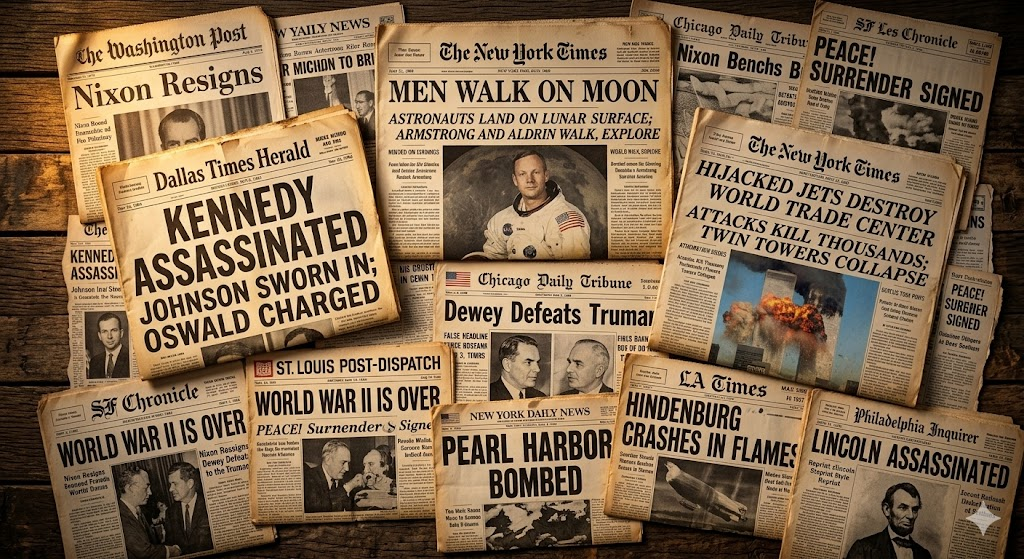
A heavy bundle of paper lands on the front porch with a thud. For generations of Americans, this daily delivery was the primary tether to the outside world. Before the era of push notifications and endless social media feeds, the front page of the morning paper dictated the conversations happening at breakfast tables, factory floors, and office buildings across the nation. The words printed in heavy black ink across the top margin did more than just announce the news. They framed reality.
The art of the newspaper headline is a delicate balancing act. Editors have only a few words and limited space to distill complex, world-altering events into a single, punchy phrase. When done correctly, a great headline captures the exact pulse of a nation. It delivers breaking news, shapes public opinion, and freezes a defining moment in time so perfectly that the physical paper itself becomes a cherished historical artifact.
Looking back through the archives offers a fascinating window into the American experience. From the devastation of global conflicts and economic collapse to the soaring heights of technological milestones and civil rights victories, print journalism has meticulously documented our national journey. The bold typography of these historic front pages continues to evoke powerful emotions decades after the ink has dried.
We are going to look closely at ten of the most iconic and historic newspaper headlines in the United States. These front pages not only kept the public informed during critical junctures, but they also left a permanent mark on the fields of journalism and historical preservation.
10 Times Newspaper Headlines Captured American History
1. “MEN WALK ON MOON” – 1969
When NASA successfully landed the Apollo 11 spacecraft on the lunar surface on July 20, 1969, newspapers across the globe scrambled to capture the magnitude of the achievement. The New York Times famously ran with the simple, declarative, and awe-inspiring headline: “MEN WALK ON MOON.”
Astronauts Neil Armstrong and Buzz Aldrin made history that day, taking a giant leap for mankind. The headline matters immensely because it documented the very first time human beings set foot on another celestial body. It represented a massive technological and scientific milestone, while also serving as a crucial ideological victory for the United States during the tense heights of the Cold War space race.
2. “DEWEY DEFEATS TRUMAN” – 1948
Not all historic headlines are famous for their accuracy. On November 3, 1948, the Chicago Daily Tribune printed one of the most infamous blunders in the history of journalism. Based on early polling and a pressing print deadline, the paper prematurely declared Republican challenger Thomas E. Dewey the winner over incumbent President Harry S. Truman.
Truman, of course, won the election. A wildly grinning Truman was later photographed holding up the erroneous front page, cementing the headline in American political lore. This incident remains a foundational lesson for journalists regarding the dangers of rushing to print without verifying final results, forever changing how newsrooms handle election night coverage.
3. “JAPAN SURRENDERS” – 1945
Following years of devastating global conflict and the dropping of two atomic bombs, the Empire of Japan formally surrendered to the Allied powers in August 1945. Newspapers across the United States splashed massive, block-letter headlines reading “JAPAN SURRENDERS” or simply “PEACE!” across their front pages.
This headline marked the definitive end of World War II, the deadliest conflict in human history. For millions of Americans waiting for loved ones to return from overseas, those bold letters represented profound relief and the beginning of a massive global rebuilding effort. It signaled the dawn of a new, complex era of geopolitics and global peace efforts.
4. “KENNEDY SHOT DEAD” – 1963
The sudden assassination of President John F. Kennedy on November 22, 1963, sent a shockwave of grief and confusion through the United States. Evening editions and extra prints hit the stands rapidly, bearing grim headlines like “KENNEDY SHOT DEAD” or “PRESIDENT ASSASSINATED.”
This event deeply traumatized the nation. Kennedy was a young, charismatic leader who represented a new frontier of American optimism. His murder changed American politics forever, ushering in a period of intense public skepticism and political unrest. The newspapers from that weekend are still preserved by many families who lived through the tragedy, serving as tangible reminders of a day when the world stood still.
5. “WALL STREET CRASH!” – 1929
In late October 1929, the roaring twenties came to a grinding, brutal halt. When the stock market experienced a catastrophic collapse, headlines like “WALL STREET CRASH!” and “BILLIONS LOST” dominated the newsstands.
This financial disaster wiped out the savings of countless ordinary citizens and signaled the immediate onset of the Great Depression. The economic collapse led to a decade of widespread unemployment, poverty, and profound social struggle. The headlines from Black Tuesday remain a stark reminder of economic fragility and the devastating human cost of unchecked financial speculation.
6. “ATTACK ON PEARL HARBOR” – 1941
On December 7, 1941, the Japanese military launched a surprise aerial strike on the United States naval base at Pearl Harbor in Hawaii. The following morning, Americans woke up to blaring headlines announcing the attack and the heavy casualties sustained by the Pacific Fleet.
This event is a major turning point in modern history. The attack violently jolted the United States out of its stance of isolationism and directly into the theater of World War II. The headlines from that Monday morning galvanized public opinion, uniting a divided nation behind a massive war effort that would ultimately reshape the entire global order.
7. “NIXON RESIGNS” – 1974
The Watergate scandal slowly eroded public trust in the executive branch over several years, culminating in a historic constitutional crisis. Facing certain impeachment, Richard Nixon announced his departure from office. On August 9, 1974, papers across the country ran variations of the same massive text: “NIXON RESIGNS.”
Nixon became the first and only U.S. president to resign from the office. This headline mattered because it validated the role of investigative journalism—spearheaded by reporters like Bob Woodward and Carl Bernstein—in holding powerful figures accountable. It proved that the democratic systems of checks and balances could withstand severe corruption at the highest levels of government.
8. “TERROR STRIKES AMERICA” – 2001
The morning of September 11, 2001, fundamentally altered the trajectory of the 21st century. As hijacked planes crashed into the World Trade Center, the Pentagon, and a field in Pennsylvania, newspapers rushed to print afternoon editions to cover the unfolding horror. The next day, headlines like “TERROR STRIKES AMERICA,” “ACT OF WAR,” and “OUR NATION SAW EVIL” blanketed newsstands.
The 9/11 attacks resulted in the tragic loss of thousands of innocent lives. The journalism from those harrowing days captured the profound vulnerability, grief, and eventual unity of the American people. The event triggered widespread changes to global security, defense protocols, and foreign policy that continue to impact our daily lives today.
9. “OBAMA ELECTED PRESIDENT” – 2008
In a historic milestone for civil rights and American politics, Barack Obama won the 2008 presidential election. On November 5, 2008, headlines proudly declaring “OBAMA ELECTED PRESIDENT” or simply “HISTORY!” were printed in massive quantities as citizens rushed to buy keepsake copies of the paper.
This headline symbolized a profound moment of change and progress for a country with a deep and painful history of racial inequality. Electing the first African American president of the United States was a highly emotional moment for millions of people. The front pages from that morning are heavily archived in museums and personal collections as a testament to the nation’s evolving identity.
10. “COVID-19 PANDEMIC” – 2020
In early 2020, a novel respiratory virus began spreading rapidly across the globe. By March, the World Health Organization made a formal declaration, prompting headlines nationwide to announce the “COVID-19 PANDEMIC.”
These headlines marked the beginning of a massive global health crisis that would completely disrupt daily life. Schools closed, businesses shuttered, and citizens were ordered to shelter in place. The pandemic resulted in immense loss of life and forced a complete social and economic transformation. Newspapers from this period document the anxiety, scientific mobilization, and societal shifts that defined the early days of the quarantine era.
The Power of Newspaper Headlines
Historic headlines hold a unique place in our culture. They serve multiple vital functions that extend far beyond simply passing along information.
First, they provide instant communication. A carefully crafted headline distills complex, multifaceted events into a few easily digestible words. It allows a passerby to understand the gravity of a situation with a single glance at a newsstand.
Second, headlines carry immense emotional impact. The specific words chosen by an editor can shape how people feel about an event. A headline can incite anger, inspire profound hope, or offer deep comfort during times of national tragedy.
Finally, these front pages act as tangible historical records. They serve as permanent snapshots of major moments in time. Reading a historical headline allows modern citizens to step back into the shoes of those who lived through the event, experiencing the shock, joy, or terror exactly as it was presented on that specific day.
Evolution of Headlines in the Digital Era
The way we consume news has changed dramatically over the last few decades. The transition from physical print to digital screens has fundamentally altered the architecture of the headline.
In the golden age of print, headlines needed to be bold, factual, and capable of selling a physical paper on a newsstand. Space was severely limited by column inches and font sizes.
Today, digital headlines are often driven by search engine optimization (SEO) and click-through rates. Editors write headlines designed to satisfy algorithms and stand out in crowded social media feeds. The modern digital headline must be short, highly engaging, and capable of generating viral interest instantly.
Despite these massive technological changes, the core purpose of the headline remains entirely unchanged. The goal is always to inform the public, engage the reader, and capture attention as quickly as possible.
Frequently Asked Questions About Historic Headlines
What makes a newspaper headline historic?
A headline becomes historic when it documents an event of massive cultural, political, or social significance. Historic headlines often announce the beginning or end of wars, major scientific breakthroughs, devastating tragedies, or unprecedented political shifts. The best ones capture the exact mood of the public at that specific moment in time.
Are physical newspapers still relevant today?
While digital media has largely overtaken physical print in terms of daily readership, physical newspapers remain highly relevant as historical artifacts. Many people still purchase physical copies of newspapers the morning after major elections, sporting championships, or national events to keep as personal souvenirs and primary historical documents.
How do editors choose the font size for a major headline?
In traditional print journalism, the font size directly correlates with the perceived importance of the event. A standard news day might feature a headline in 36-point font. However, for a world-altering event like a presidential assassination or the end of a war, editors will pull out the largest type available—sometimes called “Second Coming type”—which can span several inches in height to signify the sheer magnitude of the news.
Preserving the First Draft of History
From the towering triumph of the Apollo 11 moon landing to the devastating tragedy of the September 11 attacks, historic newspaper headlines reflect the most defining moments in the history of the United States. They remind us of the immense power of journalism to inform the public, shape complex narratives, and preserve our collective history for future generations.
As media continues to evolve and we consume news through entirely new digital mediums, these iconic front pages will always stand as timeless examples of the impact of news reporting. They are the first draft of history, printed boldly in black and white.
If you want to experience this history firsthand, consider visiting your local library or a digital newspaper archive. Browsing through the front pages of the past offers an incredible opportunity to connect with the events that built the modern world.