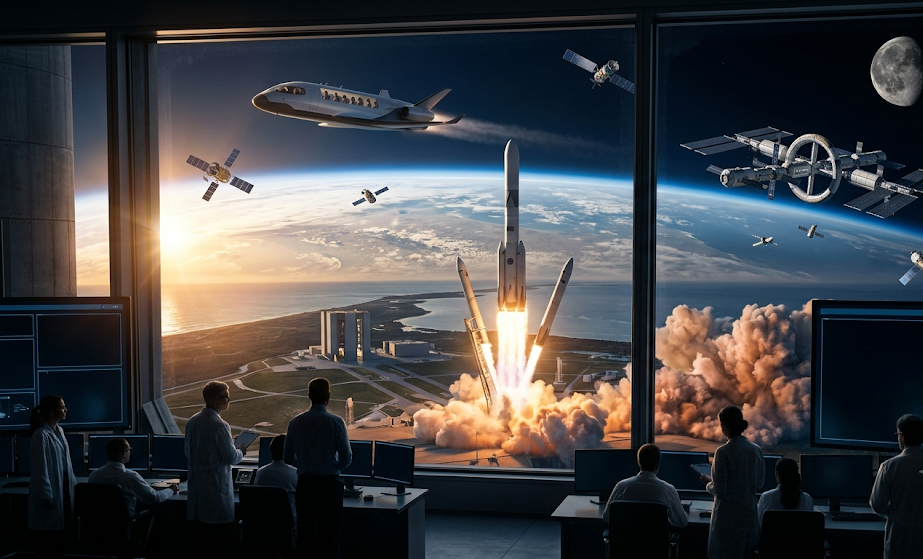
Space exploration has always represented humanity’s desire to discover the unknown. From the first artificial satellite launched into orbit to astronauts walking on the Moon and sophisticated robotic missions reaching distant planets, our understanding of the universe has expanded dramatically over the past several decades. Today, however, space exploration is entering an entirely new era. Governments are no longer the only major players in space. Private companies are investing billions of dollars in reusable rockets, commercial satellites, lunar missions, and even space tourism, making commercial space travel a reality rather than science fiction.
The rise of private aerospace companies has accelerated innovation, reduced launch costs, and opened opportunities for scientific research, telecommunications, Earth observation, and future human settlements beyond our planet. Commercial spaceflight is also changing how ordinary people think about space, with civilians now participating in orbital missions and suborbital tourism.
As global interest in the Moon, Mars, asteroid mining, and deep-space exploration continues to grow, space is becoming an important part of the global economy. Governments, scientists, engineers, entrepreneurs, and investors are working together to build technologies that could transform transportation, communication, environmental monitoring, and even the future survival of humanity.
What Is Space Exploration?
Space exploration is the investigation of outer space using spacecraft, satellites, telescopes, robotic probes, and human missions. Its primary purpose is to study celestial bodies, understand the universe, search for signs of life, and develop technologies that expand humanity’s capabilities.
Space exploration includes:
- Satellite missions
- Human spaceflight
- Lunar exploration
- Mars exploration
- Planetary science
- Space telescopes
- Asteroid missions
- Deep-space probes
- Space stations
Each mission contributes valuable scientific knowledge while advancing engineering and technology.
Understanding Commercial Space Travel
Commercial space travel refers to space activities conducted by private companies for business purposes rather than solely by government agencies.
These activities include:
- Space tourism
- Commercial satellite launches
- Cargo transportation
- Human spaceflight
- Space research
- Lunar missions
- Private space stations
- In-orbit services
The private sector is increasingly collaborating with national space agencies to expand access to space.
The Evolution of Space Exploration
The Early Space Race
The modern era of space exploration began during the Cold War when major nations competed to achieve milestones in space.
Historic achievements included:
- Launching the first satellite
- Sending the first human into space
- Landing astronauts on the Moon
These accomplishments demonstrated technological capabilities while advancing scientific understanding.
International Cooperation
In later decades, countries increasingly collaborated on scientific missions.
International partnerships enabled:
- Shared research
- Joint space missions
- International space stations
- Technology exchange
Global cooperation remains an important aspect of modern space exploration.
The Rise of Private Companies
The past two decades have seen rapid growth in commercial aerospace companies.
Private investment has accelerated innovation in:
- Rocket technology
- Satellite manufacturing
- Space tourism
- Lunar exploration
- Reusable launch systems
Competition has significantly reduced launch costs.
Why Space Exploration Matters
Space exploration benefits society in many ways beyond scientific discovery.
Scientific Research
Studying space helps scientists understand:
- Planet formation
- Climate systems
- Solar activity
- Black holes
- Galaxies
- Potential extraterrestrial environments
Research expands our understanding of the universe.
Technological Innovation
Many everyday technologies originated from space research.
Examples include:
- Satellite navigation
- Weather forecasting
- Telecommunications
- Advanced materials
- Medical imaging improvements
- Water purification technologies
Investment in space often drives innovation across multiple industries.
Earth Observation
Satellites monitor Earth’s environment by tracking:
- Climate change
- Natural disasters
- Deforestation
- Ocean temperatures
- Agricultural conditions
- Air quality
These observations support better decision-making worldwide.
Commercial Space Tourism
Space tourism has moved from imagination to reality.
Private companies now offer suborbital and orbital experiences for paying customers.
Passengers experience:
- Rocket launches
- Weightlessness
- Views of Earth from space
- Short-duration space missions
Although currently expensive, costs are expected to decrease as technology advances.
Reusable Rockets
One of the biggest breakthroughs in commercial spaceflight has been reusable rocket technology.
Traditionally, rockets were discarded after a single launch.
Reusable systems allow:
- Lower launch costs
- Faster mission preparation
- Reduced waste
- Greater launch frequency
This innovation has dramatically changed the economics of space travel.
The Growing Space Economy
The global space economy continues expanding rapidly.
Major sectors include:
- Satellite communications
- Earth observation
- Navigation services
- Space manufacturing
- Commercial launches
- Tourism
- Scientific research
As private investment increases, new business opportunities continue to emerge.
Satellites and Everyday Life
Modern society depends heavily on satellites.
They support:
- GPS navigation
- Television broadcasting
- Internet connectivity
- Mobile communications
- Banking systems
- Disaster monitoring
- Aviation
- Maritime navigation
Without satellites, many essential services would be disrupted.
Moon Exploration
The Moon has become a major focus of future missions.
Scientists hope to:
- Study lunar geology
- Search for water ice
- Build research stations
- Test technologies for Mars missions
The Moon may serve as a stepping stone for deeper space exploration.
Mars Exploration
Mars remains one of humanity’s most ambitious exploration goals.
Scientists hope future missions will:
- Search for signs of ancient life
- Study the Martian environment
- Test human survival technologies
- Prepare for future human settlements
Robotic missions continue collecting valuable scientific data.
Space Stations
Space stations provide laboratories where astronauts conduct research in microgravity.
Research areas include:
- Biology
- Medicine
- Materials science
- Physics
- Agriculture
These experiments often benefit life on Earth.
Future commercial space stations may support research, manufacturing, and tourism.
Artificial Intelligence in Space Exploration
AI is transforming space missions.
Artificial intelligence assists with:
- Spacecraft navigation
- Autonomous decision-making
- Data analysis
- Planetary mapping
- Equipment monitoring
- Mission planning
AI enables spacecraft to respond quickly without waiting for instructions from Earth.
Robotics in Space
Robotic systems perform tasks that would be difficult or dangerous for humans.
Applications include:
- Planetary rovers
- Satellite servicing
- Space station maintenance
- Sample collection
- Surface exploration
Robots extend humanity’s ability to explore distant environments.
Space Manufacturing
Future industries may manufacture products in microgravity.
Potential applications include:
- Pharmaceuticals
- Fiber optics
- Advanced materials
- Medical research
- Semiconductor production
Microgravity enables manufacturing processes impossible on Earth.
Space Mining
Asteroids contain valuable resources such as:
- Iron
- Nickel
- Platinum-group metals
- Water
Future technologies may enable commercial extraction of these resources.
Although still experimental, asteroid mining could become economically important.
Challenges of Commercial Space Travel
Despite rapid progress, several challenges remain.
High Costs
Space missions remain extremely expensive.
Developing safer, reusable technologies is essential for reducing costs.
Safety
Human spaceflight involves significant risks.
Companies continue improving:
- Spacecraft reliability
- Emergency systems
- Crew protection
- Mission monitoring
Safety remains the highest priority.
Environmental Concerns
Rocket launches generate emissions.
Researchers are exploring cleaner propulsion systems and more sustainable launch practices.
Space Debris
Thousands of inactive satellites and debris pieces orbit Earth.
Managing orbital congestion has become increasingly important.
International Collaboration
Space exploration increasingly depends on global partnerships.
Countries collaborate on:
- Scientific missions
- Planetary research
- Satellite development
- Space station operations
- Climate monitoring
Collaboration reduces costs while increasing scientific knowledge.
Careers in the Space Industry
The growing space economy creates opportunities across many professions.
Career paths include:
- Aerospace engineering
- Robotics
- Data science
- Artificial intelligence
- Satellite communications
- Space law
- Astrophysics
- Cybersecurity
- Manufacturing
- Environmental science
Demand for skilled professionals continues to increase.
The Role of Education
Future space industries require highly trained workers.
Students interested in space careers should develop knowledge in:
- Mathematics
- Physics
- Computer science
- Engineering
- Robotics
- Artificial intelligence
Practical experience through research and internships is increasingly valuable.
Space Exploration and Climate Research
Satellites help scientists understand Earth’s changing climate.
They monitor:
- Sea-level rise
- Polar ice
- Forest coverage
- Atmospheric gases
- Weather systems
- Natural disasters
These observations support environmental protection and disaster preparedness.
Ethical Considerations
As commercial space activities increase, ethical questions become more important.
Key issues include:
- Responsible use of space resources
- Environmental protection
- Planetary contamination
- Fair international access
- Space governance
International agreements will play an important role in future exploration.
Future Trends in Commercial Space Travel
Several exciting developments are expected over the coming decades.
More Affordable Space Tourism
Improved technology may lower ticket prices and increase accessibility.
Commercial Space Stations
Private companies are developing orbital facilities for research and tourism.
Lunar Bases
Scientists hope to establish permanent research stations on the Moon.
Mars Missions
Human missions to Mars remain a long-term objective.
Advanced Propulsion
Future propulsion systems may reduce travel times across the solar system.
Space-Based Manufacturing
Factories operating in orbit may produce specialized products for global industries.
Could Space Become Part of Everyday Life?
Although widespread personal space travel remains years away, many aspects of everyday life already depend on space technology.
Future possibilities include:
- Frequent commercial launches
- Point-to-point high-speed transportation
- Space hotels
- Orbital research laboratories
- Lunar industries
- Expanded satellite internet services
What once seemed impossible is gradually becoming achievable.
The Future of Humanity Beyond Earth
Many scientists believe humanity will eventually become a multi-planetary civilization.
While significant technological, financial, and environmental challenges remain, continued innovation is making long-term space habitation increasingly realistic.
Exploring other worlds may contribute to:
- Scientific discovery
- Resource development
- Planetary protection
- Human survival
- International cooperation
The journey beyond Earth has only just begun.
Conclusion
Space exploration and commercial space travel are entering one of the most exciting periods in human history. Advances in reusable rockets, artificial intelligence, robotics, satellite technology, and private investment have transformed space from a government-led endeavor into a rapidly growing global industry. Commercial companies are lowering launch costs, expanding access to space, and creating new opportunities for tourism, research, manufacturing, and communication.
At the same time, government agencies continue to pursue ambitious scientific missions to the Moon, Mars, and beyond, working alongside private organizations to push the boundaries of discovery. While challenges such as safety, environmental sustainability, cost, and space debris remain, continuous innovation is making space exploration more efficient and accessible.
As humanity looks toward a future that may include permanent lunar bases, commercial space stations, and eventually human settlements on Mars, space exploration represents far more than technological achievement. It symbolizes curiosity, collaboration, resilience, and the enduring desire to explore the unknown. The next chapter of human progress may not be written solely on Earth—it may unfold among the stars.