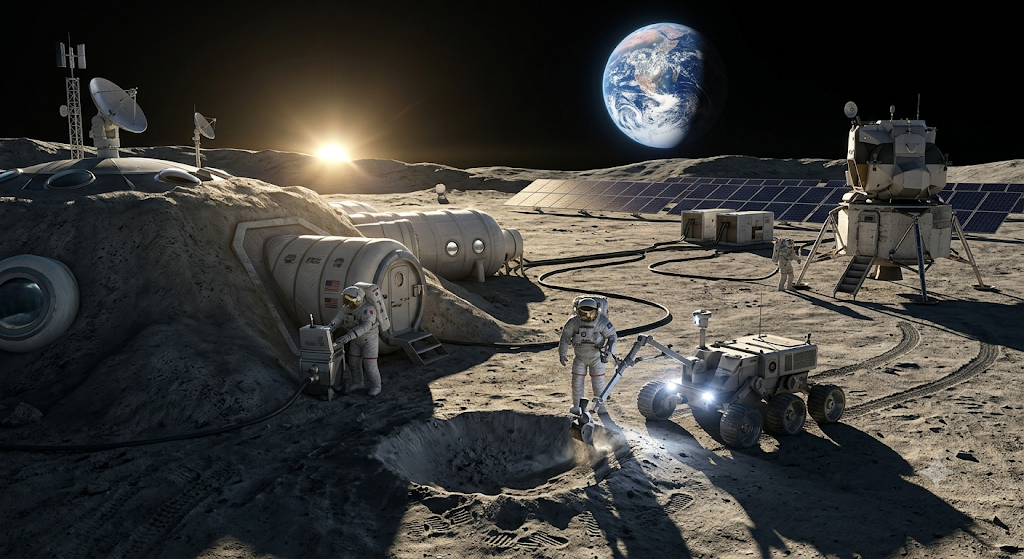
The Moon has fascinated humanity for thousands of years, inspiring myths, scientific curiosity, and ambitious dreams of exploration. In 1969, the first human footsteps on the lunar surface marked one of the greatest achievements in history. After decades of limited lunar activity, the Moon is once again becoming the center of global space exploration. Governments, private companies, and international partnerships are investing billions of dollars in new lunar missions, advanced technologies, and long-term exploration strategies.
Unlike the Moon missions of the 20th century, which primarily focused on proving technological capabilities during the Space Race, today’s missions are designed with long-term scientific, economic, and exploratory goals. Space agencies are searching for water ice near the Moon’s poles, studying lunar geology, testing new technologies, and preparing for future human missions to Mars. At the same time, commercial space companies are developing reusable rockets, robotic landers, and lunar transportation systems that could make regular Moon missions more affordable and sustainable.
The new era of Moon exploration represents much more than returning astronauts to the lunar surface. It marks the beginning of humanity’s efforts to establish a lasting presence beyond Earth. From scientific discoveries and resource utilization to international cooperation and commercial opportunities, lunar exploration is shaping the future of space exploration in ways never imagined before.
Why the Moon Matters
The Moon is Earth’s closest celestial neighbor and serves as an ideal destination for scientific research and space exploration.
Its proximity offers several advantages:
- Shorter travel time compared to Mars
- Lower mission costs
- Opportunities to test new technologies
- Scientific research in a low-gravity environment
- Preparation for deep-space missions
The Moon also preserves geological evidence that has disappeared from Earth’s surface due to weather, erosion, and tectonic activity.
A Brief History of Moon Exploration
The Early Space Race
Moon exploration accelerated during the Cold War when major nations competed to achieve space milestones.
Historic achievements included:
- Robotic flybys
- Orbital missions
- Soft lunar landings
- Sample-return missions
- Human Moon landings
These missions demonstrated remarkable engineering capabilities and expanded scientific knowledge.
Human Exploration
The first human landing on the Moon changed history forever.
Astronauts conducted experiments, collected rock samples, and demonstrated that humans could safely travel beyond Earth and return successfully.
The lunar samples continue to provide valuable scientific insights decades later.
Renewed Interest
After many years of limited activity, lunar exploration has entered a new phase driven by:
- Scientific discoveries
- Commercial investment
- Technological advances
- International collaboration
- Long-term plans for deep-space exploration
Today’s missions focus on sustainable exploration rather than one-time visits.
Goals of Modern Moon Missions
Modern lunar exploration has several important objectives.
Scientific Research
Scientists continue studying the Moon to better understand:
- Lunar geology
- Surface composition
- Impact craters
- Volcanic history
- Internal structure
- Solar system evolution
Each mission contributes valuable new information.
Searching for Water Ice
One of the biggest discoveries of recent decades is evidence suggesting water ice exists in permanently shadowed regions near the Moon’s poles.
Water could support future astronauts by providing:
- Drinking water
- Oxygen production
- Rocket fuel through hydrogen extraction
Finding accessible water resources is critical for long-term exploration.
Preparing for Mars Missions
The Moon serves as a testing ground for technologies required for future missions to Mars.
Engineers can evaluate:
- Habitat systems
- Power generation
- Radiation protection
- Life support
- Surface vehicles
- Resource utilization
Lessons learned on the Moon reduce risks for longer missions.
Why the Moon Is Important for Future Space Exploration
The Moon offers unique advantages.
Lower Gravity
Launching spacecraft from the Moon requires much less energy than launching from Earth.
Future lunar bases could become important transportation hubs for deep-space exploration.
Resource Availability
Scientists continue studying lunar resources including:
- Water ice
- Oxygen-rich minerals
- Metals
- Regolith for construction
Using local resources reduces dependence on Earth-based supplies.
Scientific Laboratories
The Moon provides an excellent location for:
- Astronomy
- Geological studies
- Physics experiments
- Long-duration human research
Its stable environment supports scientific investigations impossible on Earth.
Technologies Driving Modern Moon Missions
Reusable Rockets
Reusable launch systems have dramatically reduced the cost of space missions.
Benefits include:
- Lower launch expenses
- Faster mission turnaround
- Greater mission frequency
- Improved sustainability
Affordable launches make regular lunar missions more practical.
Advanced Lunar Landers
Modern landers feature:
- Precision landing systems
- Autonomous navigation
- Hazard detection
- Improved fuel efficiency
These technologies increase mission safety and reliability.
Robotics
Robotic explorers perform tasks before human arrival.
Robots assist with:
- Mapping terrain
- Collecting samples
- Building infrastructure
- Monitoring equipment
- Exploring hazardous regions
They reduce risks for astronauts.
Artificial Intelligence
AI supports lunar exploration by enabling:
- Autonomous navigation
- Mission planning
- Equipment monitoring
- Scientific data analysis
- Surface mapping
AI helps spacecraft make rapid decisions during missions.
Building Sustainable Lunar Bases
Unlike previous missions, future lunar exploration aims to establish long-term human presence.
Potential infrastructure includes:
- Living habitats
- Research laboratories
- Solar power systems
- Communication networks
- Landing pads
- Resource processing facilities
These bases may support continuous scientific research.
International Cooperation
Modern Moon exploration increasingly involves international partnerships.
Countries collaborate on:
- Scientific research
- Technology development
- Spacecraft design
- Mission planning
- Data sharing
International cooperation reduces costs while increasing scientific capabilities.
The Role of Private Space Companies
Commercial companies are transforming lunar exploration.
Private organizations contribute through:
- Rocket launches
- Lunar landers
- Cargo transportation
- Spacecraft components
- Communication systems
- Surface technologies
Competition encourages innovation while lowering costs.
Lunar Science
Scientists hope future missions will answer important questions.
Research areas include:
Lunar Formation
Understanding how the Moon formed helps explain Earth’s early history.
Geological Activity
Scientists continue studying volcanic regions, tectonic features, and impact history.
Space Weather
The Moon provides opportunities to study how solar radiation affects planetary surfaces.
Astronomy
Far-side lunar observatories may enable highly sensitive astronomical observations due to reduced radio interference.
Living on the Moon
Permanent human presence requires solving several challenges.
Life Support
Astronauts need reliable systems for:
- Air
- Water
- Food
- Waste management
- Temperature control
Radiation Protection
Without Earth’s atmosphere and magnetic field, the Moon experiences intense radiation.
Future habitats may use underground shelters or protective construction materials.
Energy Production
Solar power is expected to become the primary energy source for lunar bases.
Energy storage systems will support operations during extended lunar nights.
Economic Opportunities
The growing lunar economy may create opportunities in:
- Aerospace engineering
- Robotics
- Satellite communications
- Construction technologies
- Resource extraction
- Scientific research
- Manufacturing
Commercial investment continues increasing as exploration expands.
Lunar Resources
Scientists are investigating whether lunar resources can support future exploration.
Potential resources include:
- Water ice
- Oxygen
- Silicon
- Aluminum
- Titanium
- Rare minerals
Using local materials could reduce transportation costs from Earth.
Challenges Facing Moon Missions
Despite remarkable progress, several obstacles remain.
High Costs
Space exploration requires significant financial investment.
Although launch costs continue declining, lunar missions remain expensive.
Extreme Temperatures
The Moon experiences dramatic temperature variations between day and night.
Equipment must withstand these harsh conditions.
Dust
Lunar dust is highly abrasive and can damage machinery, spacesuits, and equipment.
Managing dust remains an engineering challenge.
Communication Delays
Although shorter than Mars missions, communication still requires careful planning for complex operations.
Moon Missions and Climate Research
Lunar technologies often benefit Earth.
Advances developed for space missions contribute to:
- Renewable energy
- Water purification
- Medical devices
- Robotics
- Environmental monitoring
Space research frequently produces innovations with everyday applications.
Education and Future Careers
The renewed focus on lunar exploration creates demand for skilled professionals.
Students interested in space careers should develop expertise in:
- Physics
- Mathematics
- Aerospace engineering
- Computer science
- Robotics
- Artificial intelligence
- Materials science
Space industries increasingly require multidisciplinary knowledge.
Moon Missions and Commercial Innovation
Commercial participation has accelerated technological progress.
Companies compete to develop:
- Affordable rockets
- Autonomous spacecraft
- Lunar communication systems
- Cargo transportation
- Surface vehicles
Competition encourages continuous innovation.
Future Moon Mission Technologies
Several emerging technologies are expected to play important roles.
3D Printing
Future astronauts may construct buildings using lunar soil instead of transporting construction materials from Earth.
Autonomous Construction
Robotic systems may build landing pads, habitats, and infrastructure before human arrival.
Nuclear Power Systems
Compact nuclear reactors may provide reliable electricity during long lunar nights.
Advanced Space Suits
Future suits will improve:
- Mobility
- Safety
- Dust resistance
- Temperature regulation
Preparing for Mars
Many experts view the Moon as the ideal preparation ground for future Mars exploration.
Astronauts can test:
- Long-duration habitation
- Resource utilization
- Medical support
- Surface operations
- Emergency procedures
Experience gained on the Moon will help reduce risks during much longer Mars missions.
The Future of Lunar Exploration
The coming decades may include:
- Permanent lunar research stations
- Commercial cargo services
- Regular astronaut missions
- Expanded international cooperation
- Space-based manufacturing
- Resource utilization
- Scientific observatories
The Moon may become humanity’s first permanent destination beyond Earth.
Why Moon Missions Matter for Humanity
Lunar exploration extends beyond scientific curiosity.
It contributes to:
- Technological innovation
- International collaboration
- Economic development
- Scientific discovery
- Educational inspiration
- Long-term human survival
The knowledge gained benefits both Earth and future generations.
Conclusion
The new era of Moon missions marks the beginning of an exciting chapter in human exploration. Unlike the early lunar missions that focused on reaching the Moon first, today’s efforts are centered on building a sustainable future beyond Earth. Advances in reusable rockets, artificial intelligence, robotics, precision landing systems, and commercial space technologies are making lunar exploration more practical, affordable, and scientifically valuable than ever before.
Modern Moon missions are helping scientists unlock the secrets of lunar geology, search for water ice, test technologies for future Mars expeditions, and explore ways to establish long-term human habitats. At the same time, growing collaboration between governments, private companies, and international partners is accelerating innovation and creating new opportunities within the expanding space economy.
Although challenges such as extreme temperatures, radiation, high mission costs, and lunar dust remain significant, continuous technological progress is bringing humanity closer to a permanent presence on the Moon. As exploration continues, the Moon is evolving from a distant destination into a gateway for deeper space exploration. The discoveries and technologies developed during this new era of lunar missions will not only shape the future of space travel but also inspire generations to continue pushing the boundaries of human knowledge and achievement.