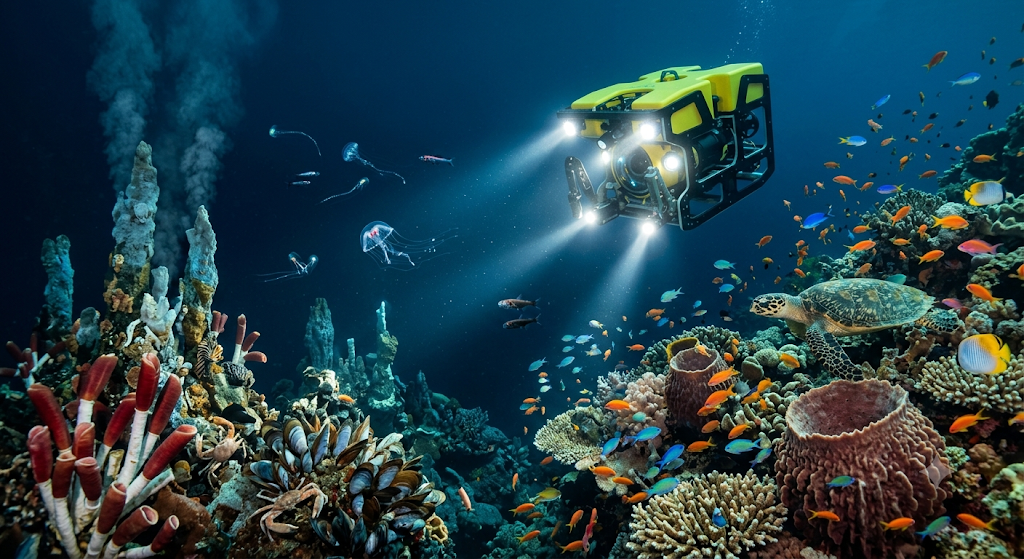
While humanity has made remarkable progress exploring outer space, much of our own planet remains a mystery. More than 70% of Earth’s surface is covered by oceans, yet scientists estimate that over 80% of the ocean remains unexplored, unobserved, and unmapped. Beneath the waves lies a vast world of unique ecosystems, deep-sea creatures, underwater mountains, hydrothermal vents, shipwrecks, and valuable natural resources waiting to be discovered.
Ocean exploration and marine research have become increasingly important in the 21st century as climate change, pollution, overfishing, and biodiversity loss threaten marine ecosystems. Scientists, governments, universities, and private organizations are investing in advanced technologies to better understand the oceans and develop sustainable solutions for protecting them.
Modern marine research combines artificial intelligence (AI), autonomous underwater vehicles (AUVs), remotely operated vehicles (ROVs), satellite technology, underwater robotics, environmental DNA (eDNA), and big data analytics to study the ocean in unprecedented detail. These innovations are helping researchers discover new species, monitor marine habitats, predict natural disasters, improve fisheries management, and uncover valuable insights into Earth’s climate system.
As interest in the blue economy continues to grow, ocean exploration is becoming essential not only for scientific discovery but also for sustainable economic development, environmental conservation, renewable energy, and global food security.
What Is Ocean Exploration?
Ocean exploration is the systematic investigation of the world’s oceans using scientific methods and advanced technologies to better understand marine environments, ecosystems, geology, chemistry, and biology.
It involves studying:
- Deep-sea ecosystems
- Marine biodiversity
- Ocean currents
- Coral reefs
- Underwater volcanoes
- Ocean chemistry
- Marine geology
- Fisheries
- Coastal environments
- Polar oceans
Unlike routine monitoring, exploration focuses on discovering unknown areas and expanding scientific knowledge.
Understanding Marine Research
Marine research is the scientific study of ocean life, ecosystems, physical processes, and environmental changes.
Researchers investigate topics such as:
- Marine biology
- Oceanography
- Climate science
- Marine ecology
- Fisheries science
- Coastal management
- Ocean engineering
- Marine conservation
The knowledge gained supports environmental protection and sustainable use of ocean resources.
Why Ocean Exploration Matters
The oceans influence nearly every aspect of life on Earth.
Climate Regulation
Oceans absorb vast amounts of heat and carbon dioxide, helping regulate the global climate.
Marine research improves climate models by studying:
- Ocean circulation
- Carbon storage
- Heat distribution
- Sea-level rise
Oxygen Production
Marine plants and microscopic phytoplankton produce a significant portion of the oxygen in Earth’s atmosphere.
Healthy oceans are essential for maintaining atmospheric balance.
Food Security
Millions of people depend on seafood as a primary source of protein.
Marine research supports sustainable fisheries and protects fish populations from overexploitation.
Economic Importance
The blue economy contributes trillions of dollars annually through industries such as:
- Shipping
- Fisheries
- Tourism
- Offshore energy
- Biotechnology
- Marine manufacturing
Sustainable management ensures long-term economic benefits.
The Mystery of the Deep Ocean
The deep sea remains one of the least explored environments on Earth.
Extreme conditions include:
- Total darkness
- Crushing pressure
- Near-freezing temperatures
- Limited food availability
Despite these harsh conditions, scientists continue discovering extraordinary life forms adapted to survive in these environments.
Technologies Transforming Ocean Exploration
Autonomous Underwater Vehicles (AUVs)
AUVs operate independently without human control.
They collect valuable data on:
- Ocean depth
- Water temperature
- Salinity
- Seafloor mapping
- Marine habitats
These robotic vehicles can explore areas too dangerous for human divers.
Remotely Operated Vehicles (ROVs)
ROVs are connected to research vessels through cables and controlled by operators on the surface.
They are equipped with:
- High-definition cameras
- Robotic arms
- Scientific sensors
- Sample collection equipment
ROVs enable detailed exploration of deep-sea environments.
Artificial Intelligence
AI has become an essential tool in marine research.
Scientists use AI to:
- Identify marine species
- Analyze underwater images
- Predict fish migration
- Monitor coral reefs
- Detect illegal fishing
- Process massive environmental datasets
AI significantly improves research efficiency.
Satellite Technology
Satellites monitor large-scale ocean conditions.
They provide information about:
- Sea surface temperature
- Ocean currents
- Algal blooms
- Ice coverage
- Storm development
- Coastal changes
Satellite observations support climate science and disaster preparedness.
Mapping the Ocean Floor
Only a small percentage of the seafloor has been mapped in high resolution.
Modern sonar technologies help scientists identify:
- Underwater mountains
- Deep trenches
- Canyons
- Volcanoes
- Fault lines
Accurate maps improve navigation, scientific research, and hazard assessment.
Marine Biodiversity Research
Ocean exploration continues revealing new species every year.
Scientists study:
- Deep-sea fish
- Jellyfish
- Corals
- Sponges
- Crustaceans
- Marine microorganisms
Understanding biodiversity helps protect fragile ecosystems and supports medical research.
Coral Reef Conservation
Coral reefs support approximately one-quarter of all marine species despite covering only a small portion of the ocean floor.
Marine researchers monitor:
- Coral bleaching
- Water quality
- Reef restoration
- Fish populations
- Climate impacts
Conservation efforts help preserve these valuable ecosystems.
Deep-Sea Ecosystems
Hydrothermal vents support unique ecosystems powered by chemical energy rather than sunlight.
Scientists study these environments to better understand:
- Extreme life forms
- Evolution
- Earth’s geological activity
- Potential extraterrestrial life
These discoveries reshape our understanding of biology.
Marine Biotechnology
Marine organisms produce compounds with significant scientific and medical value.
Researchers investigate marine life for:
- New antibiotics
- Cancer treatments
- Anti-inflammatory drugs
- Industrial enzymes
- Cosmetic ingredients
Marine biotechnology continues expanding rapidly.
Ocean Research and Climate Change
Marine research plays a vital role in understanding climate change.
Scientists monitor:
- Ocean warming
- Acidification
- Melting polar ice
- Carbon absorption
- Sea-level rise
These observations improve environmental forecasting and policymaking.
Plastic Pollution Research
Plastic pollution threatens marine ecosystems worldwide.
Researchers investigate:
- Microplastics
- Wildlife impacts
- Waste movement
- Recycling technologies
- Cleanup strategies
Reducing marine pollution requires scientific evidence and international cooperation.
Sustainable Fisheries
Marine science helps prevent overfishing.
Researchers study:
- Fish populations
- Breeding cycles
- Migration patterns
- Habitat quality
Sustainable management ensures healthy marine ecosystems and long-term food supplies.
Renewable Ocean Energy
The ocean offers several renewable energy opportunities.
These include:
- Offshore wind farms
- Wave energy
- Tidal power
- Ocean thermal energy conversion
Marine research supports environmentally responsible energy development.
Underwater Archaeology
Ocean exploration also uncovers human history.
Researchers discover:
- Ancient shipwrecks
- Lost settlements
- Historical trade routes
- Cultural artifacts
These findings provide valuable insights into past civilizations.
Marine Protected Areas
Governments increasingly establish protected marine regions to conserve biodiversity.
Protected areas help:
- Restore fish populations
- Protect endangered species
- Preserve coral reefs
- Support ecosystem recovery
Scientific monitoring evaluates their effectiveness.
Environmental DNA (eDNA)
Environmental DNA technology allows scientists to identify marine species using genetic material found in seawater.
Benefits include:
- Non-invasive monitoring
- Faster biodiversity assessments
- Detection of rare species
- Improved conservation planning
eDNA is transforming marine biology.
Ocean Robotics
Modern robotic systems perform complex underwater tasks including:
- Infrastructure inspection
- Scientific sampling
- Pipeline monitoring
- Search missions
- Habitat surveys
Robotics improve safety while expanding research capabilities.
Challenges Facing Ocean Exploration
Despite remarkable technological advances, significant challenges remain.
Extreme Pressure
Deep-sea environments exert enormous pressure on equipment.
Specialized engineering is required for exploration vehicles.
High Costs
Research vessels, underwater robots, and scientific instruments require major financial investment.
International collaboration helps reduce costs.
Remote Locations
Many ocean regions remain difficult to access due to weather, distance, and limited infrastructure.
Data Management
Modern ocean research generates enormous amounts of information requiring advanced computing and artificial intelligence.
Careers in Marine Science
Growing investment in ocean research has created diverse career opportunities.
Popular fields include:
- Marine biologist
- Oceanographer
- Marine ecologist
- Fisheries scientist
- Ocean engineer
- Environmental consultant
- Underwater robotics specialist
- Marine conservationist
- Climate scientist
- Data analyst
Demand for multidisciplinary expertise continues increasing.
Skills Needed for Future Marine Scientists
Students interested in marine research should develop knowledge in:
- Biology
- Chemistry
- Physics
- Mathematics
- Environmental science
- Artificial intelligence
- Data analytics
- Robotics
- Geographic Information Systems (GIS)
Interdisciplinary skills improve career opportunities.
The Blue Economy
The blue economy promotes sustainable use of ocean resources while supporting economic growth.
Key sectors include:
- Fisheries
- Tourism
- Marine biotechnology
- Shipping
- Renewable energy
- Coastal infrastructure
Balancing development with conservation remains essential.
Future Technologies in Ocean Exploration
Several emerging technologies will shape marine research over the coming decade.
AI-Powered Ocean Monitoring
Artificial intelligence will provide real-time environmental monitoring and predictive analysis.
Swarm Robotics
Groups of autonomous underwater robots may explore vast ocean regions simultaneously.
Smart Ocean Sensors
Connected sensor networks will continuously monitor water quality, biodiversity, and climate conditions.
Advanced Imaging
Next-generation underwater cameras and sonar systems will produce highly detailed maps and biological observations.
International Cooperation
Ocean conservation requires global collaboration.
Countries increasingly share:
- Scientific data
- Research vessels
- Monitoring systems
- Conservation strategies
- Climate observations
International partnerships strengthen marine protection efforts.
The Future of Ocean Exploration
The coming decades promise exciting developments in marine science.
Researchers expect advances in:
- Deep-sea mapping
- Marine biotechnology
- Climate forecasting
- Sustainable fisheries
- Renewable energy
- Ocean robotics
- Biodiversity monitoring
As technologies improve, scientists will gain unprecedented understanding of Earth’s largest ecosystem.
Conclusion
Ocean exploration and marine research are unlocking the mysteries of one of the least understood regions of our planet. Advances in artificial intelligence, underwater robotics, autonomous vehicles, satellite technology, environmental DNA, and marine biotechnology are enabling scientists to explore deeper, collect more accurate data, and better understand the complex interactions that sustain ocean life.
These discoveries have far-reaching implications for climate science, biodiversity conservation, sustainable fisheries, renewable energy, public health, and economic development. At the same time, growing challenges such as ocean warming, pollution, habitat destruction, and declining marine biodiversity highlight the urgent need for continued research and international cooperation.
As humanity looks toward a more sustainable future, protecting and understanding the oceans will remain a global priority. By investing in scientific innovation, supporting marine conservation, and responsibly managing ocean resources, we can ensure that the world’s oceans continue to support life, inspire discovery, and contribute to prosperity for generations to come.