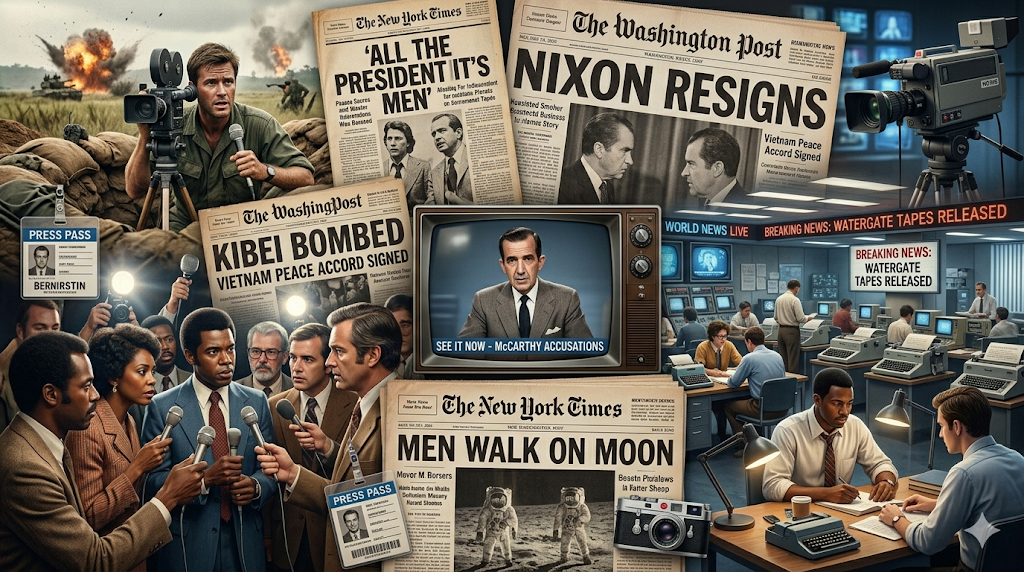
Journalism has played a powerful role in shaping societies, exposing corruption, documenting wars, and informing the public during some of the most important events in history. Throughout the decades, journalists have risked their lives, challenged governments, and uncovered truths that changed the world forever.
From groundbreaking investigative reporting to unforgettable live broadcasts, iconic journalism moments remind us why a free press is essential in a democratic society. These moments not only transformed media history but also influenced politics, public opinion, human rights, and global awareness.
In this article, we explore the top 10 most iconic journalism moments in history, their impact on society, and why they continue to inspire journalists around the world.
Why Iconic Journalism Matters
Journalism is often called the “fourth pillar of democracy” because it holds power accountable and informs citizens. Iconic journalism moments show the importance of truth, courage, and ethical reporting.
Great journalism can:
- Expose corruption
- Reveal hidden truths
- Influence public policy
- Protect democracy
- Raise awareness during crises
- Give voice to ordinary people
- Preserve historical records
The following journalism moments changed the media industry and left a permanent mark on world history.
1. The Watergate Scandal Investigation (1972–1974)
One of the Greatest Investigative Journalism Stories Ever
The Watergate scandal is widely regarded as one of the most iconic examples of investigative journalism in history.
Reporters Bob Woodward and Carl Bernstein from The Washington Post uncovered a political scandal involving members of U.S. President Richard Nixon’s administration.
The investigation began after a break-in at the Democratic National Committee headquarters at the Watergate complex in Washington, D.C.
Why It Was Historic
The journalists discovered illegal activities, political spying, and attempts to cover up the truth. Their reporting eventually led to:
- Congressional investigations
- Public outrage
- Nixon’s resignation in 1974
It was the first time a U.S. president resigned from office.
Impact on Journalism
Watergate strengthened investigative journalism worldwide and proved that journalists could hold powerful leaders accountable.
2. The Pentagon Papers Publication (1971)
Revealing Government Secrets
The Pentagon Papers were classified documents about the Vietnam War leaked by military analyst Daniel Ellsberg.
The New York Times published the documents despite intense pressure from the U.S. government.
Why This Was Important
The papers revealed that the government had misled the public about the Vietnam War for years.
The publication sparked a major legal battle about freedom of the press and government censorship.
Historic Outcome
The U.S. Supreme Court ruled in favor of the newspapers, protecting press freedom under the First Amendment.
This case became a landmark victory for journalism and free speech.
3. Live Television Coverage of the Moon Landing (1969)
Journalism Reaches Space
When humans first landed on the moon during the Apollo 11 Moon Landing, millions of people around the world watched the event live on television.
Journalists and broadcasters brought one of humanity’s greatest achievements directly into homes worldwide.
Why It Became Iconic
The live coverage connected global audiences in a shared historic experience.
Famous words spoken by astronaut Neil Armstrong became part of history:
“That’s one small step for man, one giant leap for mankind.”
Impact on Media
The event demonstrated the growing power of television journalism and live broadcasting.
4. Reporting During World War II
Courageous Journalism in Dangerous Times
World War II produced some of the most fearless journalism ever seen.
War correspondents reported directly from battlefields, documenting destruction, suffering, and military operations.
Famous War Journalists
Journalists such as Edward R. Murrow became famous for powerful radio broadcasts from war zones.
Murrow’s reporting from London during German bombings gave listeners a vivid understanding of wartime realities.
Why It Was Historic
These reports:
- Humanized the war
- Informed global audiences
- Preserved historical truth
- Changed broadcast journalism forever
War reporting became one of journalism’s most respected fields.
5. The Fall of the Berlin Wall Coverage (1989)
A Historic Political Transformation
The fall of the Fall of the Berlin Wall symbolized the end of the Cold War and the reunification of Germany.
Television journalists broadcast emotional scenes of people celebrating, crossing borders, and tearing down the wall.
Why It Was Memorable
Millions watched history unfold live on television.
The event represented:
- Freedom
- Political change
- The collapse of division in Europe
Media Impact
Global media coverage made the event one of the defining television journalism moments of the 20th century.
6. The Exposure of the Abu Ghraib Prison Abuse Scandal (2004)
Journalism Exposes Human Rights Violations
Investigative journalism exposed shocking abuse of prisoners by U.S. military personnel at Abu Ghraib prison in Iraq.
Photographs and reports revealed torture and mistreatment inside the prison.
Why It Became a Major Journalism Story
The scandal sparked:
- International outrage
- Military investigations
- Global debates on human rights
Importance for Journalism
The story showed how journalism can expose abuse and demand accountability even during wartime.
7. Coverage of the September 11 Attacks (2001)
A Defining Moment for Live News Reporting
The terrorist attacks on September 11, 2001 changed journalism forever.
News channels provided nonstop live coverage as hijacked planes struck the World Trade Center and the Pentagon.
Why It Was Historic
Journalists had to report breaking news under extreme uncertainty and emotional pressure.
The coverage became one of the most watched live news events in history.
Impact on Journalism
After 9/11:
- 24-hour news coverage expanded rapidly
- Digital journalism accelerated
- Global news networks became more influential
The event reshaped modern broadcast journalism.
8. The Panama Papers Investigation (2016)
One of the Largest Journalism Collaborations Ever
The Panama Papers Leak investigation involved hundreds of journalists from multiple countries working together.
The leaked documents exposed how wealthy individuals and political leaders used offshore accounts to hide money and avoid taxes.
Why It Was Revolutionary
The project demonstrated the power of international collaborative journalism.
It also showed how modern journalists use digital tools and data analysis.
Major Outcomes
The investigation led to:
- Political resignations
- Criminal investigations
- Financial reforms in several countries
9. CNN’s Gulf War Live Coverage (1991)
The Birth of 24-Hour Global News
During the Gulf War, CNN provided live reporting directly from Baghdad.
This was one of the first wars extensively covered in real time on television.
Why It Changed Journalism
Viewers experienced war coverage instantly as events unfolded.
The Gulf War established CNN as a global news leader and transformed the future of live international reporting.
Lasting Effects
The event accelerated:
- Real-time journalism
- Global news broadcasting
- Continuous live reporting
10. The #MeToo Investigations (2017)
Journalism Sparks a Global Movement
Investigative reports published by journalists at The New York Times and The New Yorker exposed allegations of sexual misconduct against film producer Harvey Weinstein.
Why It Became Historic
The reporting triggered the global #MeToo movement, encouraging survivors worldwide to speak openly about harassment and abuse.
Impact on Society
The investigations led to:
- Criminal charges
- Workplace reforms
- Greater awareness of gender inequality
The story demonstrated journalism’s power to drive social change.
Common Traits Behind Iconic Journalism Moments
Although these events happened in different eras, they share several common qualities.
Courage
Journalists often faced threats, pressure, or danger while reporting important stories.
Persistence
Investigative reporting requires patience, research, and determination.
Truth-Seeking
The primary goal of journalism remains uncovering and sharing accurate information.
Public Service
Great journalism serves society by informing citizens and exposing wrongdoing.
How Journalism Has Changed Over Time
The journalism industry has evolved dramatically across decades.
Print Journalism Era
Newspapers once dominated global information sharing.
Radio Journalism
Radio brought immediate news updates during wars and emergencies.
Television Journalism
Television added visuals and live reporting to storytelling.
Digital Journalism
Today, online platforms, social media, podcasts, and mobile journalism dominate the media landscape.
Modern journalists now combine:
- Writing
- Video production
- Data analysis
- Social media reporting
- Multimedia storytelling
Why Journalism Remains Important Today
Even in the digital age, journalism remains essential for democracy and public awareness.
Quality journalism helps society by:
- Fighting misinformation
- Exposing corruption
- Reporting facts accurately
- Giving voice to communities
- Promoting accountability
As artificial intelligence and social media continue to change the media world, ethical journalism becomes more important than ever.
Lessons Journalism Students Can Learn From These Historic Moments
Students interested in journalism can gain valuable lessons from these iconic events.
Always Verify Facts
Accuracy is the foundation of journalism credibility.
Protect Sources
Confidential sources often help expose corruption and injustice.
Be Fearless
Great journalism sometimes requires challenging powerful institutions.
Stay Ethical
Journalists must balance public interest with fairness and responsibility.
Adapt to Technology
Modern journalists must understand digital storytelling and multimedia reporting.
The Future of Journalism
Journalism continues to evolve rapidly because of technology, artificial intelligence, and social media.
Future journalism trends include:
- AI-assisted reporting
- Data journalism
- Mobile journalism
- Independent journalism platforms
- Podcast journalism
- Interactive storytelling
However, despite technological changes, the core mission of journalism remains unchanged: telling the truth and informing the public.
Final Thoughts
The most iconic journalism moments in history prove the extraordinary power of reporting and storytelling. From exposing political scandals to documenting wars and social movements, journalists have helped shape public understanding of major world events.
These historic moments demonstrate that journalism is not simply about delivering news. It is about courage, truth, accountability, and the responsibility to inform society.
Whether it was the Watergate investigation, the Panama Papers leak, or the live coverage of the moon landing, each event changed journalism forever and inspired future generations of reporters.
For journalism students and media professionals, studying these iconic moments offers valuable lessons about investigative reporting, ethics, storytelling, and the enduring importance of a free press in society.